Being a translator in
Astana I quite often provide military translation services – for trainings,
general discussions and strategic planning.
Last week I had a chance to interpreter a course on Psychology in Leadership run by the Royal Military Academy Sandhurst, UK.
Military translation
is always a challenge but it is also extremely interesting. Special terminology
plays a huge role as well as background knowledge – it’s important to be up to
date with military conflicts, both past and present. Knowledge of ranks,
military branches and units is a must.
Working with military is also very different to working with civilians so an interpreter should be familiar with such military concepts as hierarchy, discipline, punctuality.
It was a great honor
for me to receive a certificate of attendance of the course; I am grateful for
all the knowledge and skills I have acquired during the training.
6 months into the pandemic and
by now, all the interpreting assignments have moved online in a form of
webinars, videoconferences, online trainings etc.
How does it work and which platforms are used for RSI? Here is a brief overview.
The most popular platform is without any doubt – Zoom. User friendly, affordable, intuitive. 99% of my work is done through Zoom these days: two language channels, mute button, mic on/off, participants list, chat –once a mic is on you can barely notice you are working online. All those advantages come at a price, unfortunately, and this price is security. Zoom conferences have been hacked countless times with inappropriate content suddenly popping up on everybody’s screen. It is for this reason that many international organizations stay clear of Zoom.
There are other,
interpretation specific difficulties in Zoom –it is impossible to hear your booth
partner while interpretation is on. Meaning handover is quite a challenge.
Different interpreters solve this issue in different ways – some prefer logging
into the conference using a second device (another computer, tablet or ever a
smartphone will do) and a second pair of headset; others make a parallel
video/audio phone call. It is also possibly to rely on exchanging ready- steady
– go -it’s your turn – kind of messages in Zoom chat (always privately!) or
regular messengers. Either way, it is a
bit of an inconvenience but interpreters make do because really that is what
the clients mostly prefer.
There are other platforms that are used less frequently, mainly due to their high price: KUDO, Speakus, Interactio, Verspeak and others. Some (but definitely not all) organizations are ready to pay a higher price in exchange for a secured online meeting.
From the simultaneous interpreters’ point of view it’s important to keep in mind you have to be certified by some of these platforms (or get a brief onboarding training) before you are allowed to work on these as an interpreter.
Fortunately, the variety of RSI platforms is quite big and one can choose a solution that meets their requirements.
COVID-19 pandemic has brought about a lot of changes into our professional and personal lives. Conference interpreting industry was hit very hard as all the big (and small) events got cancelled. Many clients postponed everything that they planned until things got back to “normal”. Half a year into pandemic and “normal” isn’t really back. Instead, there is a “new normal” – working remotely and providing RSI – remote simultaneous interpretation services.
RSI has its advantages and disadvantages: while interpreters have many more responsibilities now (we basically became our own simultaneous interpretation technicians), new opportunities opened up as well. It became so much easier to get access to new markets, to work all around the globe in different time zones while never leaving your home office and not even being in the same room as your booth partner. Many love it, many hate, most tolerate it and everybody misses offline events and coffee breaks 🙂
Zoom has become our main means of communication, zoom calls and zoom
call tests are daily occurrence in our lives these days. Since no one really
know when the pandemic is going to be over we might as well embrace all the new
technologies, platforms and handover functions.
All in all, like many other professionals, simultaneous interpreters are
doing their best to make lemonade out of 2020 lemons.
On March 1-2nd I worked as a simultaneous translator for the Industry Outreach event within the EU project in Kazakhstan on dual-use goods.
Simultaneous translation in Astana
Starting in August 2015 the Implementation Phase of EU-Kazakhstan Cooperation has achieved another stage. After conducting several Outreach activities for licensing and customs officers in the Republic of Kazakhstan, this event was dedicated to Kazakh companies involved in foreign trade activities. Involving EU licensing and customs experts as well as European industry representatives this activity demonstrated the importance of constant and transparent communication between the public and private sectors. The main objective of this event was to bring both parties together and to provide best practices of cooperation models in the EU as well as to engage the industry.
It was my pleasure to work for yet another event with the EU project in Kazakhstan.
On May, 11-12th I worked as a simultaneous English-Russian interpreter in Astana, at the Nazarbayev University at the 4th International Scientific Conference on regenerative medicine and healthy aging.
English translator at Nazarbayev University
The conference was really multidisciplenary as it touched upon such issues as risk factors of the coronary heart disease, rodon-induced lung cancer, treatment of end-stage liver desease as well as targeted sequencing and carbon wound dressings. As it happens quite often at medical conferences, the speaker do not provide organizers with their presentations ahead of time due to intellectual property reasons, so interpreters cannot prepare for the conference which make the work so much more difficult. The topics were also very varied: they ranged frm cardiology to oncology, from gerontology to neurology which means as a translator you have to be prepared for everythign and anything.
Finally two challenging but interesting days are over and among other things that I learnt at the conference I now know there is an app for mobile phones that can track wrinkles on one’s face 🙂
On February 24-25th the second Expo 2017 International Participants Meeting was held in Astana where I worked as a simultaneous French-Russian interpreter. The first IPM was held in November 2014 where I worked as an English-Russian translator.
French translator for Expo 2017 in Astana
International participants were presented with the information on work progress in terms of organization of and preparation for Expo 2017 in Astana. They learned about how the construction is going, what is done in th area of marketing, ticketing, how Kazakhstan is planning on attracting millions of visitors to the Expo 2017.
The participants were very active during these two days, they asked questions about safety and security, about a possibility to have a day or even a week of African culture during Expo. After two vety intensive days they were able to see the construction site with their own eyes and get an idea of what Expo 2017 in Astana will look like.
About 10 participation countries were signed during IPM, it is expected that Expo 2017 in Astana will host about 100 countries, some will be represented as a region, international organizations and NGOs will be present as well.
I have been involved in Expo since 2012 when Kazakhstan just submitted its application dossier and hosted an Equiry Mission. Back then 2017 seem very far away and now we are at the finish line just a year away from this exciting event. I am really looking forward to Expo 2017 in Astana!
Last week I had a great honor of translating the President of the Republic of Kazakhstan Nursultan Nazarbayev. He participated in the Nazarbayev University graduation ceremony in order to personaly issue diplomas to the best students; I was providing English-Russian simultaneous translation services during the ceremony.
Translating for the President N.Nazarbayev in Astana
Eventhough translating the President is a great responsibility (and quite a lot of pressure, too), it went very smoothly: the President is a great speaker; he knows how to deliver a speech keeping in mind he is being interpreted at the moment.
The President opened the ceremony which was continued by speeches delivered by university’s faculty members; diplomas were issued to bachelor and master degree students.
I am sure it was a great honor for them too to receive such an important document from the hands of the President.
I wish all the best to alumni of the Nazarbayev University, let theor professional lives be as impressive as their graduation ceremony!
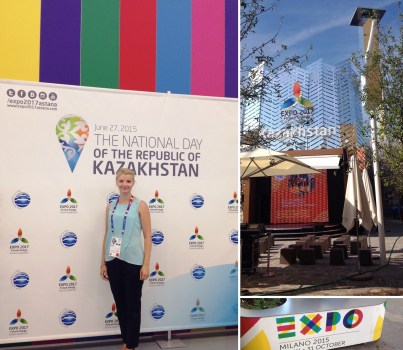
In June 2015 I was lucky to be invited to Milan as an English-Russian interpreter for Expo 2015. Kazakhstan participates in the Expo 2015 and its pavillion is one of the most popular ones. On June,27th Kazakhstan celebrates its National day: a big official delegation from Astana came to Milan, Kazakhstan’s pavillion was visited by several high-level delegations from other countries, including one from Italy headed by its Prime-Minister. I was there to provide translation services from English to Russian and vice versa.
Together with the Kazakh delegation I had a chance to visit other pavillions, for example UAE pavillion, the country to host Expo 20202. Some other impressive pavillions were those of Germany, Japan, Azerbajan, etc.
Unfortunately I didn’t have much time for visiting other pavillions as I was mainly involved in the negitiations in the Kazakh pavillion between different delegations.
Celebration continued with a big concert which starred famous Kazakh dancers, singers, craftsmen. The idea of the National Day is to show a country’s culture and in the case of Kazakhstan also get people intetersted in visiting Expo 2017 in Astana.
Eventful but short trip to Italy came to an end and so I am headed home for more translation work in Astana.
On April, 9th 2015 I worked as a simultaneous Russian-English translator at the I Eurasian Congress of Gerontologists.
The Congress gathered scientists from Kazakhstan, Russia, Belarus, Ukraine, USA, Japan with the participation of the State Secretary of Kazakhstan and the Minister of healthcare and social protection of Kazakhstan.
Reports were delivered on topics like: “Molecular Aspects of Peptide Regulation of Ageing”, “Heart tissue engineering”, “Geriatric Frailty and Its Prevention as a Concept of Modern Gerontology”, “Treatment of Comorbidities Improves Overall Survival and Quality of Life of Brain Tumor Patients” and many others.
It was the first time that I had a chance to translate this area of medicine but its terminology is not that specific; it has a lot of terms from a general medicine, such as cardio-vascular deceases, diabetes, malignant tumor, mortality, healthy life style, etc.
I have learnt a lot of interesting things: for example, it is not a good idea to switch on bright light at night as it reduces the level of melatonin being produced in out bodies which protects us from ageing. Or that there is such thing as light pollution: our cities are never in complete darkness, they are highly illuminated which is again not good for our bodies that should be experiencing darkness at night and light during day time.
In other words, the Congress was very informative and fuitful, scientists have shared their achievements and new ideas with each other. Now thanks to my work I know a little bit more about how to live a long and healthy life and, as Ashley Montagu said, better die young as late as possible.
After winning the right to host Expo 2017 in Astana, the national company “Astana Expo 2017” decided to conduct a number of seminars for the developping countries in order to discuss their plans for Expo.
The first seminar that was held in Astana gathered countires of the Carribean region. Representatives of the Caribbean countries gave presentations about the energy in their region, development of the alternative energy source, initiatives for green economy. The national company also gave a couple of presentations about the construction of the Expo site, its master plan, content plan, and others. The countries needed to decide how they want to be present as a region in a so-called Carribean Plaza, they needed to find similarities that they wanted to demonstrate including culture, music, dance, diversity, etc.
After the official part of the seminar the guests had a chance to see Astana, they went to Baiterek and Han Shatyr, they saw a horse show and they were very impressed by the kazakh hospitality.
By the end of the seminar a number of recommendations were worked out, the work will continue to develop the concept of the Carribean Plaza.
On October, 2-3rd I translated from Russian to English and English to Russian at the second congress of traumatologists-orthopaedists of the Republic of Kazakhstan.
My task was quite challenging as medical translation should always be very specific, topics like hip replacement, short legs, different types of prothesis, congenital dislocation of hip, arthroplasty were discussed in great details.
The night before translation was very intense I had to read up on traumas quite a bit both in Russian and English. I didn’t become a doctor over a night of course, but I read enough to differ between talus and patella, shin bone and spoke bone, lavage and sanitation.
During the forum lectures were given by the guests from Germany, the UK and Luthuania. Questions and answers session followed each lecture. Participants were eager to know why cementless prothesis is better than cement one, why metal leg of prothesis has a better effect than the ceramics one, in which cases fast track surgery can be used, etc.
I definitely learned a lot about hip replacement and its prevention. I have prepared my own glossary of terms related to traumatology and orthopaedics, so hopefully next time it will be easier!
On October, 6-8th I worked at the Global E-Government Forum 2014 held in Astana with the help of the UN agencies.
Participants from all over the world came to Astana to discuss issues such as e-goverment, open government, smart governance, open data, etc.
The first day of the forum was dedicated specifically to the open data discussion; representatives of the World Bank gave speeches, as well as those who had already implemented open data projects in their countries: Azerbaijan, Moldova, Russia, etc.
The second day of the forum started with the panel session with the participation of the Prime Minister of Kazakhstan, then participants could choose one of many parallel sessions to discuss e-government with different experts. With my collegue I provided simultaneous translation services at the Round Table of Ministers from over 20 countries.
The third day of the forum continued with numerous parallel sessions. I translated at a session where main focus of the discussion was on new opportunities and challenges that smart governance represents.
On April, 23-24th I worked as a simultaneous English-Russian and Russian –English translator at the 5th Roadmap meeting on Foot-and-Mouth decease in Western Eurasia.
The meeting was organized jontly by the Ministry of Agriculture of Kazakhstan and OIE – World organization for animal health. Representatives of over 15 countries came to the meeting: Kazakhstan, Russian, Uzbekistan, Georgia, Turkey, Armenia and others; each of the country delivered a report on FMD situation in the respected countries.
Issues such as vaccination, decease control, prevention measures, monitoring and others were discussed. The meeting was quite technical; representatives of the World Reference Laboratory spoke about different strains of the virus and the measures to be taken in the case of an outbreak.
The meeting resulted in recommendations developped by the participants and ended with a presentation of a new sub-regional FMD coordination office in Astana, Kazakhstan.
For a week I worked as a translator for the Secretary General of the Bureau of International Expositions (BIE) – H.E. V.Loscertales who came to Astana for a work visit for the first time after the city won the right to host Expo 2017 in Astana.
Secretary General’s visit to Astana started with a meeting with the Prime Minister of Kazakhstan. Mr. Loscertales expressed his congratulations to the Prime Minister on the occasion of Astana’s victory a couple months earlier in Paris. Prime Minsiter reassured Mr. Loscertales that all the preparatory works necessary for a successful organization of EXPO 2017 will be done according to the schedule and will be closely monitored by the Government.
We then had another meeting, this time with the Minister of Foreign Affairs of Kazakhstan. The Ministry is responsible for ensuring a high level of participation at the EXPO 2017.
The following day started with a press conference during which Mr. Loscertales answered to a numerous questions that the kazakhstani media had. Press conference was followed by more meetings: with the National Coordinator of the project Expo 2017; the meeting in “AstanaGenPlan” – the office for urban planning of Astana where the main architects of Astana explained how Astana will change by 2017 and where the Expo plot will be located.
The next meeting was with the Mayor of Astana who underlined the need for infrastructure development in Astana which would include building a new railway station, expanding the existing international airport and construction of new hotels, among many other developments.
On the last day of his stay in Astana Mr. Loscertales met with the President of the Republic of Kazakhstan Nursultan Nazarbayev.
After a short but very intense visit Secretary General returned to Paris to come back to Astana in half a year with a new inspection mission to follow the progress of the city’s preparation for the international event to be held in just a couple of years – EXPO 2017.
On May, 22-24th I provided simultaneous translation services at the VI Astana Economic Forum. The Forum is a big-scale annual event and it is the third time that I participate in the Forum.
The second day we were at the session: “Entrepreneurship in Kazakhstan: challenges and opportunities” which was followed by the sessions on transition to a green economy and by a political discussion on Kazakhstan, Russia and the EU with a participation of a former President of Poland.
Together with my collegue we worked at a session dedicated to Expo 2017 Astana and the fact that I am actively involved in that project really helped as I knew the speakers and the materials they were presenting.
We also provided simulatenous English-Russian and Russian -English translation during the participants’ dinner.
Besides its numerous sessions, the Forum offers a big variety of side events, many foreign companies and Embassies participate in those events.
The couple days during the Forum are always very busy for the translators, translators are booked couple months in advance to ensure their availability. Additional interpreters are brought from Almaty, Moscow and other cities to provide a necessary number of translators that the Forum requires.
Annualy the Forum gathers schientists, businessmen, and journalists from all over the world. It is a great honor to be a part if this huge event.
Another event as a part of the promotion campaign “Astana – candidate city to host EXPO 2017” is the official reception “Yacht de Paris” that was held in Paris on behalf of the Government of the Republic of Kazkahstan.
The reception that was held on the yacht cruising Seine gathered about 160 BIE delegates with their spouses. The reception with the theme “Dances of four continents” had an official part during which the speeches were delivered by H.E. Ambassador of Kazakhstan to France, Minister N. Kapparov, national coordinator R.Zhoshybaev and a french actor Vincent Perez. The official part was followed by dances from four continents letting the guests learn more about each other’s culture: Viennese waltz and feerie representing Europe, Chinese and Indian dances representing Asia, oriental dance and “jungle” dance showcasing Africa, salsa and samba being traditional Latin American dances.
My role was to “meet and greet” guests as they were arriving to the yacht, then make sure I was available if they needed me to translate their conversations, at the end I was responsible for seeing the guests off.
The atmosphere at the reception was very warm, even hot when everybody started dancing to the rhythm of latin american music. This reception was the last event of the promotion campaign before the day X – the day when the BIE delegates will vote for either Astana or Liege to be the host of EXPO 2017.
Another event in the framework of the lobbying campaign of Astana city candidate to host EXPO 2017 was the reception held on behalf of the Government of the Republic of Kazakhstan in Paris on October, 25th.
BIE delegates – Ambassadors of more than 150 countries were kindly invited to attend the reception during which the bilateral negotiations were held as well as the speeches were delivered by the Kazakh and international officials.
The cycling team “Sun Trip” was presented to the public: the team has a very ambitious idea of crossing the continent on electric bikes starting in Paris and finishing in Astana as the promotion of the very theme of Astana Expo 2017 – Future Energy. In relation to that, 6 bikes were raffled off to those who came to the reception. To the surprise and the pleasure of the audience, it was Alexander Vinokurov who was responsible for that part.
I was actively involved in the preparation of the event, including translation of its programme, getting in touch with the embassies and making sure the Ambassadors were coming, as well as helping out during the reception itself in case if anybody needed translation.
Everybody seemed to enjoy the reception with its nice jazz band, food and possibility to interact in an unformal way.
Last two weeks I worked as a Russian-English translator in Bangkok, Thailand as a part of the EXPO 2017 in Astana promotion campaign. I had started working for EXPO 2017 in February and I had a number of assignments since then.
This time I came to Bangkok to organize and translate meetings between the Government of Kazakhstan and the Ambassadors based in Thailand as well as for the UN ESCAP Advisory Committee of Permanent Representatives Session.
First week was spent for preparations: together with my colleague we mainly worked with the Embassy of Kazakhstan to Thailand; we found conference room for meetings, hotel for the Kazakh delegation, a place for the reception.
Next week when the main delegation arrived from Kazakhstan we started meetings with Ambassadors to ask for support of Astana candidacy to host EXPO 2017. After two days of meetings the representative of Kazakhstan delivered a speech at the Session of the Advisory Committee of the Permanent Representatives of UN ESCAP.
Once all the official meetings were over, the Embassy of Kazakhstan invited Ambassadors to the reception where video materials on EXPO 2017 Astana projects were demonstrated. I translated during the reception as well.
The trip was very interesting as it was my first time in South-East Asia: in spite of the busy schedule I had a chance to explore the city a little bit and got to know a small part of the thai culture: people are nice and smiling, always trying to help foreigners who are a bit lost in such an exotic place.
Yesterday for the first time I did simultaneous French-Russian translation for the 3rd meeting of the country-members of TURKSOY (International Organization for the Turcic Culture) on UNESCO –related questions.
Previously I worked as a consecutive French-Russian interpreter and as a simultaneous English-Russian interpreter but never as a simultaneous French-Russian interpreter. There is always first time, as they say. Plus I also worked with the Astana Mayor’s office on the UNESCO-related issues so I was more or less prepared.
Most of the speeches were held in Russian, so my main translation was Russian-French: speeches were delivered on the natural, tangible and intangible cultural heritage of the world. Representatives of different Turkic countries (Kazakhstan, Turkmenistan, Azerbaijan, Turkey, republics of Saha, Tatarstan and others) spoke of historical monuments, manuscripts, legends, traditional music and songs of their countries and the ways to preserve this heritage.
There was a speech from the French scientist M.Fischler who shared his impressions and thoughts on his visits to the mausoleum of Khodja Achmed Yassawi in Kazakhstan, he also touched upon the works of two prominent scientists and philosophers such as Al Farabi and Yasawi. This speech I translated from French to Russian.
The conference continued on the next day where I combined the knowledge of both French and English because eventhough the main translation was Russian-French, one of the speeches was delivered in English and I had to quickly “switch” languages in my head. I worked at the session where participants discussed how the countries can preserve the documentary heritage, such as manuscripts, legends and historical books and works. The collaboration in this area is especially important because not all the works of a scientist are kept in one country, sometimes they are scattered around many countries and without helping each other the countries might lose the heritage altogether.
I was very happy to have this opportunity to try myself in simultaneous French-Russian translation and it seems that it didn’t go bad at all so I will be even happier to continue!
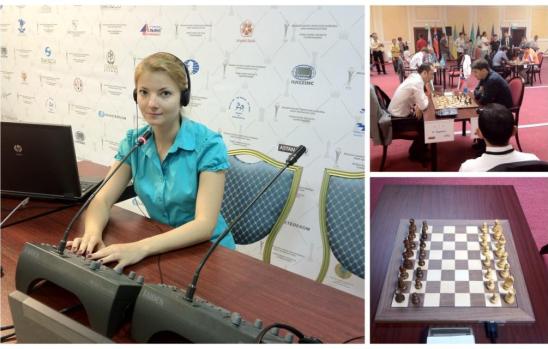
On July, 5th I worked as a simultaneous English-Russian translator at the World Blitz and Rapid Chess Championships. For the first time the Championships were held in Astana.
To translate during the Chess Championship was a very unusual and interesting task, the topic is so much different from that of the conferences where I normally work.
To my surprise the conference that preceded the championship started in the Kazakh language which I don’t speak but understand somewhat. For the first couple moments I was expecting the translation into Russian but then I realized that it wasn’t provided. Which means I had to “improvize” and translate from Kazakh to English directly which I wouldn’t normally do but I thought it was better to go ahead than keep silent. Plus it wasn’t that difficult! There were questions about the winning fund, about guests’ impressions on Astana, about the championship’s participants.
The conference was brief but very interesting as I already said. The following day I came to the Championship as a visitor: I play chess myself and I couldn’t miss the opportunity to watch a real game! There were 8 games played at the same time and I had hard time following them all. Eventually I chose one and stuck to it.
It was a very enriching experience both professionally and personally. I am happy to have participated in the Championship in Astana!