You are currently browsing the archives for the Foreigners in Kazakhstan category.
May 17th, 2016
On May, 11-12th I worked as a simultaneous English-Russian interpreter in Astana, at the Nazarbayev University at the 4th International Scientific Conference on regenerative medicine and healthy aging.
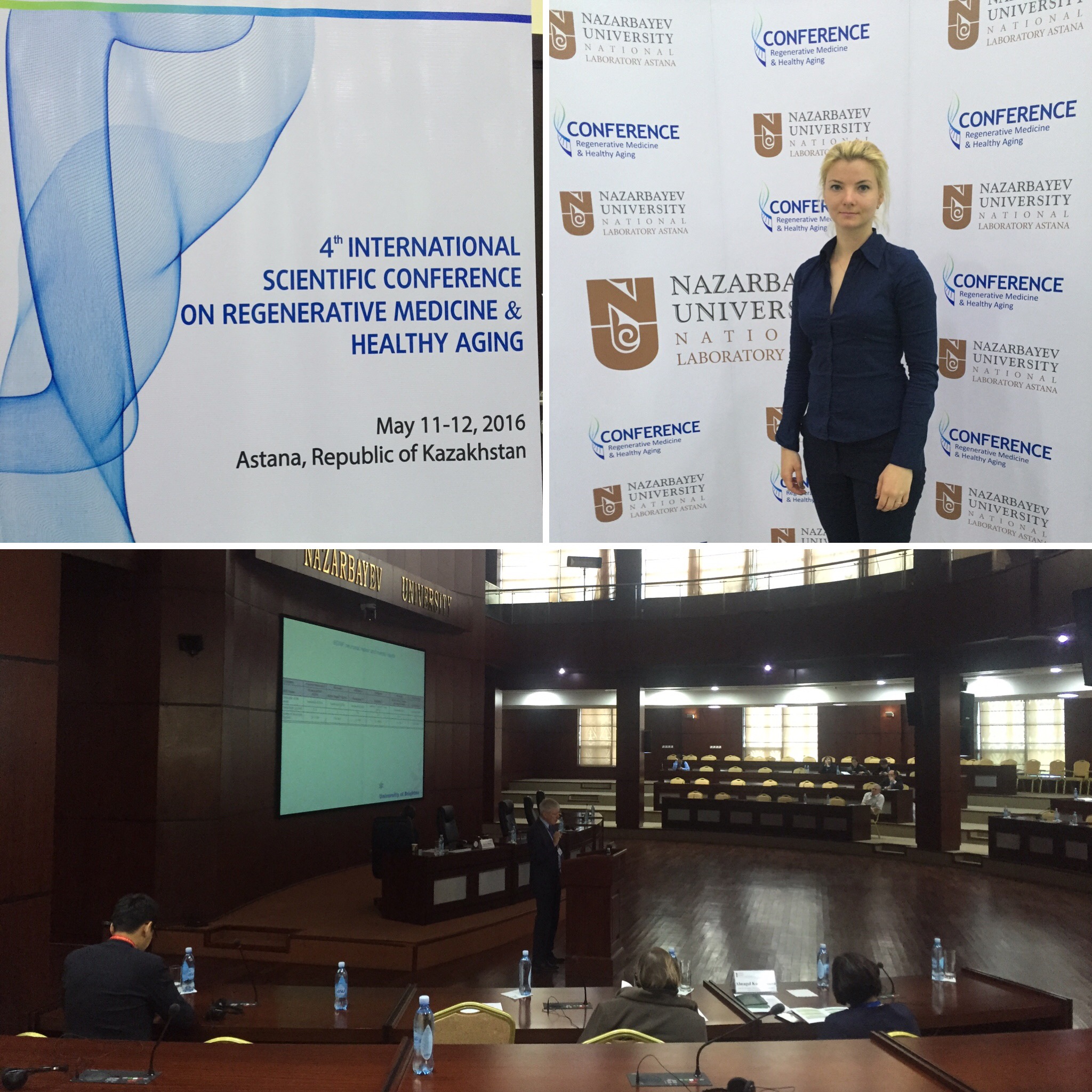
English translator at Nazarbayev University
The conference was really multidisciplenary as it touched upon such issues as risk factors of the coronary heart disease, rodon-induced lung cancer, treatment of end-stage liver desease as well as targeted sequencing and carbon wound dressings. As it happens quite often at medical conferences, the speaker do not provide organizers with their presentations ahead of time due to intellectual property reasons, so interpreters cannot prepare for the conference which make the work so much more difficult. The topics were also very varied: they ranged frm cardiology to oncology, from gerontology to neurology which means as a translator you have to be prepared for everythign and anything.
Finally two challenging but interesting days are over and among other things that I learnt at the conference I now know there is an app for mobile phones that can track wrinkles on one’s face 🙂
Tags: English-Russian simultaneous translation, interpreter Nazarbayev University, medical translation astana
Posted in About Kazakhstan, Astana, Foreigners in Kazakhstan, Interpreter Astana, medical translation, News, Simultaneous translation, translation services, translation Астана
» No Comments
February 27th, 2016
On February 24-25th the second Expo 2017 International Participants Meeting was held in Astana where I worked as a simultaneous French-Russian interpreter. The first IPM was held in November 2014 where I worked as an English-Russian translator.

French translator for Expo 2017 in Astana
International participants were presented with the information on work progress in terms of organization of and preparation for Expo 2017 in Astana. They learned about how the construction is going, what is done in th area of marketing, ticketing, how Kazakhstan is planning on attracting millions of visitors to the Expo 2017.
The participants were very active during these two days, they asked questions about safety and security, about a possibility to have a day or even a week of African culture during Expo. After two vety intensive days they were able to see the construction site with their own eyes and get an idea of what Expo 2017 in Astana will look like.
About 10 participation countries were signed during IPM, it is expected that Expo 2017 in Astana will host about 100 countries, some will be represented as a region, international organizations and NGOs will be present as well.
I have been involved in Expo since 2012 when Kazakhstan just submitted its application dossier and hosted an Equiry Mission. Back then 2017 seem very far away and now we are at the finish line just a year away from this exciting event. I am really looking forward to Expo 2017 in Astana!
Tags: Astana, astana interprete, expo 2020 translator, expo translator, french translation astana, french translator astana, IPM, translation Kazakhstan, translator for expo 2017
Posted in About Kazakhstan, Abu Dhabi, Advice column, Astana, Exhibition, Expo 2015 Milan, EXPO 2017, Expo 2020 russian interpreter, Expo Astana 2017, Fairs, Foreigners in Kazakhstan, Interpreter Astana, Le Français, News, Simultaneous translation, tours in Astana, translation services, translation Астана, Астана
» No Comments
April 10th, 2015
On April, 9th 2015 I worked as a simultaneous Russian-English translator at the I Eurasian Congress of Gerontologists.
The Congress gathered scientists from Kazakhstan, Russia, Belarus, Ukraine, USA, Japan with the participation of the State Secretary of Kazakhstan and the Minister of healthcare and social protection of Kazakhstan.

Reports were delivered on topics like: “Molecular Aspects of Peptide Regulation of Ageing”, “Heart tissue engineering”, “Geriatric Frailty and Its Prevention as a Concept of Modern Gerontology”, “Treatment of Comorbidities Improves Overall Survival and Quality of Life of Brain Tumor Patients” and many others.
It was the first time that I had a chance to translate this area of medicine but its terminology is not that specific; it has a lot of terms from a general medicine, such as cardio-vascular deceases, diabetes, malignant tumor, mortality, healthy life style, etc.

I have learnt a lot of interesting things: for example, it is not a good idea to switch on bright light at night as it reduces the level of melatonin being produced in out bodies which protects us from ageing. Or that there is such thing as light pollution: our cities are never in complete darkness, they are highly illuminated which is again not good for our bodies that should be experiencing darkness at night and light during day time.
In other words, the Congress was very informative and fuitful, scientists have shared their achievements and new ideas with each other. Now thanks to my work I know a little bit more about how to live a long and healthy life and, as Ashley Montagu said, better die young as late as possible.
Tags: medical translation astana, medical translator astana, Russian-English simultaneous translator, simultaneous interpreter astana, Translator Astana
Posted in Astana, Foreigners in Kazakhstan, medical translation, News, Sessions, Simultaneous translation, translation services, Астана
Comments Off on Russian-English translation at the I Eurasian Congress of Gerontologists.
October 11th, 2014
After winning the right to host Expo 2017 in Astana, the national company “Astana Expo 2017” decided to conduct a number of seminars for the developping countries in order to discuss their plans for Expo.

The first seminar that was held in Astana gathered countires of the Carribean region. Representatives of the Caribbean countries gave presentations about the energy in their region, development of the alternative energy source, initiatives for green economy. The national company also gave a couple of presentations about the construction of the Expo site, its master plan, content plan, and others. The countries needed to decide how they want to be present as a region in a so-called Carribean Plaza, they needed to find similarities that they wanted to demonstrate including culture, music, dance, diversity, etc.
After the official part of the seminar the guests had a chance to see Astana, they went to Baiterek and Han Shatyr, they saw a horse show and they were very impressed by the kazakh hospitality.
By the end of the seminar a number of recommendations were worked out, the work will continue to develop the concept of the Carribean Plaza.
Tags: english translation expo, Expo Astana 2017, seminar expo, translator expo astana, translator seminar
Posted in About Kazakhstan, Astana, EXPO 2017, Expo Astana 2017, Fairs, FAQ, Foreigners in Kazakhstan, News, Simultaneous translation, tours in Astana, translation services
Comments Off on Translation at the EXPO seminar for the Carribean Region
October 11th, 2014
On October, 2-3rd I translated from Russian to English and English to Russian at the second congress of traumatologists-orthopaedists of the Republic of Kazakhstan.

My task was quite challenging as medical translation should always be very specific, topics like hip replacement, short legs, different types of prothesis, congenital dislocation of hip, arthroplasty were discussed in great details.
The night before translation was very intense I had to read up on traumas quite a bit both in Russian and English. I didn’t become a doctor over a night of course, but I read enough to differ between talus and patella, shin bone and spoke bone, lavage and sanitation.
During the forum lectures were given by the guests from Germany, the UK and Luthuania. Questions and answers session followed each lecture. Participants were eager to know why cementless prothesis is better than cement one, why metal leg of prothesis has a better effect than the ceramics one, in which cases fast track surgery can be used, etc.
I definitely learned a lot about hip replacement and its prevention. I have prepared my own glossary of terms related to traumatology and orthopaedics, so hopefully next time it will be easier!
Tags: English-Russian simultaneous translation, forum astana, medical congress astana, medical translation
Posted in About Kazakhstan, Astana, Foreigners in Kazakhstan, medical translation, Simultaneous translation, translation services
Comments Off on Simultaneous Translation at the congress of traumatologists and orthopaedists
October 11th, 2014
On October, 6-8th I worked at the Global E-Government Forum 2014 held in Astana with the help of the UN agencies.

Participants from all over the world came to Astana to discuss issues such as e-goverment, open government, smart governance, open data, etc.
The first day of the forum was dedicated specifically to the open data discussion; representatives of the World Bank gave speeches, as well as those who had already implemented open data projects in their countries: Azerbaijan, Moldova, Russia, etc.

The second day of the forum started with the panel session with the participation of the Prime Minister of Kazakhstan, then participants could choose one of many parallel sessions to discuss e-government with different experts. With my collegue I provided simultaneous translation services at the Round Table of Ministers from over 20 countries.
The third day of the forum continued with numerous parallel sessions. I translated at a session where main focus of the discussion was on new opportunities and challenges that smart governance represents.
Tags: astana translation, e-government forum astana, e-government Kazakhstan, english translation in Astana, forum astana
Posted in About Kazakhstan, Astana, Foreigners in Kazakhstan, Simultaneous translation, translation services
Comments Off on English Translation at the Global E-Government Forum
May 8th, 2014
On April, 23-24th I worked as a simultaneous English-Russian and Russian –English translator at the 5th Roadmap meeting on Foot-and-Mouth decease in Western Eurasia.

The meeting was organized jontly by the Ministry of Agriculture of Kazakhstan and OIE – World organization for animal health. Representatives of over 15 countries came to the meeting: Kazakhstan, Russian, Uzbekistan, Georgia, Turkey, Armenia and others; each of the country delivered a report on FMD situation in the respected countries.
Issues such as vaccination, decease control, prevention measures, monitoring and others were discussed. The meeting was quite technical; representatives of the World Reference Laboratory spoke about different strains of the virus and the measures to be taken in the case of an outbreak.
The meeting resulted in recommendations developped by the participants and ended with a presentation of a new sub-regional FMD coordination office in Astana, Kazakhstan.
Tags: FMD conference astana, FMD office in astana, russian translator astana, simultaneous translator Astana
Posted in Astana, Foreigners in Kazakhstan, Simultaneous translation, translation services, Workshops
Comments Off on Translation at the Roadmap meeting on Foot-and-Mouth decease
June 10th, 2013
For a week I worked as a translator for the Secretary General of the Bureau of International Expositions (BIE) – H.E. V.Loscertales who came to Astana for a work visit for the first time after the city won the right to host Expo 2017 in Astana.

Secretary General’s visit to Astana started with a meeting with the Prime Minister of Kazakhstan. Mr. Loscertales expressed his congratulations to the Prime Minister on the occasion of Astana’s victory a couple months earlier in Paris. Prime Minsiter reassured Mr. Loscertales that all the preparatory works necessary for a successful organization of EXPO 2017 will be done according to the schedule and will be closely monitored by the Government.
We then had another meeting, this time with the Minister of Foreign Affairs of Kazakhstan. The Ministry is responsible for ensuring a high level of participation at the EXPO 2017.
The following day started with a press conference during which Mr. Loscertales answered to a numerous questions that the kazakhstani media had. Press conference was followed by more meetings: with the National Coordinator of the project Expo 2017; the meeting in “AstanaGenPlan” – the office for urban planning of Astana where the main architects of Astana explained how Astana will change by 2017 and where the Expo plot will be located.

The next meeting was with the Mayor of Astana who underlined the need for infrastructure development in Astana which would include building a new railway station, expanding the existing international airport and construction of new hotels, among many other developments.
On the last day of his stay in Astana Mr. Loscertales met with the President of the Republic of Kazakhstan Nursultan Nazarbayev.

After a short but very intense visit Secretary General returned to Paris to come back to Astana in half a year with a new inspection mission to follow the progress of the city’s preparation for the international event to be held in just a couple of years – EXPO 2017.
Tags: Astana expo 2017, BIE Secretary General, Expo 2017 translator, russian translation in astana, translator for Prime Minister
Posted in About Kazakhstan, Astana, Exhibition, EXPO 2017, Expo Astana 2017, Foreigners in Kazakhstan, Interpreter in Paris, News, translation services
Comments Off on Translator for BIE Secretary general – Expo 2017 in Astana
June 8th, 2013
On May, 22-24th I provided simultaneous translation services at the VI Astana Economic Forum. The Forum is a big-scale annual event and it is the third time that I participate in the Forum.

The second day we were at the session: “Entrepreneurship in Kazakhstan: challenges and opportunities” which was followed by the sessions on transition to a green economy and by a political discussion on Kazakhstan, Russia and the EU with a participation of a former President of Poland.
Together with my collegue we worked at a session dedicated to Expo 2017 Astana and the fact that I am actively involved in that project really helped as I knew the speakers and the materials they were presenting.

We also provided simulatenous English-Russian and Russian -English translation during the participants’ dinner.
Besides its numerous sessions, the Forum offers a big variety of side events, many foreign companies and Embassies participate in those events.
The couple days during the Forum are always very busy for the translators, translators are booked couple months in advance to ensure their availability. Additional interpreters are brought from Almaty, Moscow and other cities to provide a necessary number of translators that the Forum requires.
Annualy the Forum gathers schientists, businessmen, and journalists from all over the world. It is a great honor to be a part if this huge event.
Tags: Astana Economic Forum, Astana Economic Forum translator, book a translator, simultaneous interpreter astana, simultaneous translator almaty, Translator Astana
Posted in AEF, Astana, EXPO 2017, Expo Astana 2017, Foreigners in Kazakhstan, Sessions, Simultaneous translation, translation services
» No Comments
August 30th, 2012
Last two weeks in August I worked as an English-Russian translator in the Nazarbayev Intellectual School during the training provided by the Cambridge University. The training provided the local high school teachers with an opportunity to discuss the new curriculum for all school subjects with the Cambridge trainers.

First four days I worked with physics teachers, next two – with geography teachers and the last four days with mathematics teachers. Throughout two weeks training we covered a lot of topics such as active learning, student oriented learning, types of feedback and question types, we discussed different resources that can be used during the lessons, we played games that are aimed at engaging students in the active work, we conducted scientific experiments with the materials available in the classroom.
All that time I felt like being back in high school myself: Newton’s laws, gravity, conservation of momentum, functions, sea salinity – all started coming back to me. We watched a short video on astronomy, on our position in the solar system, galaxies and new stars formation – what a great chance to learn something new!
Actually I’ve learned a lot about teaching techniques which was exceptionally interesting for me since I was teaching French in Astana to high school students and I could easily use these techniques and approaches in my work. I learned about different types of activities linked to the Bloom’s taxonomy that help students better understand, memorize, analyze and create knowledge. I have already heard about the Bloom’s taxonomy during my previous translation tasks when I worked in the National Testing center. I am always happy to realize I learn something new from my work and can use the acquired knowledge later on.
It is exciting to be a part of the team that is developing new school course programmes and is implementing it. It will be challenging for both teachers and students, especially since the teaching will be done in three languages: Russian, Kazakh and English, but challenges only make our lives more interesting, don’t they?
Tags: english translator astana, English-russian translation astana, russian translator astana
Posted in Astana, Foreigners in Kazakhstan, translation services, Workshops
» No Comments
July 17th, 2012
As the follow-up of the EXPO 2017 Astana candidacy promotion campaign I worked as a simultaneous translator in Astana at the Symposium which gathered 160 International Bureau of Exhibition’s delegates from all over the world.
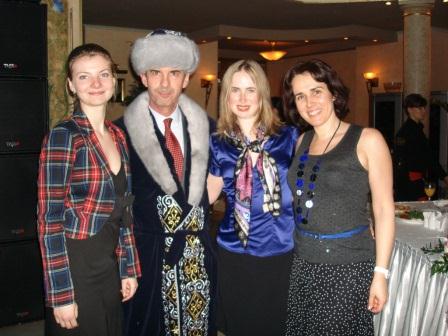
Symposium was organized to show Astana to the delegates who will later vote for the city to host EXPO 2017. The idea was to explain in more details the theme of EXPO 2017 – Future Energy as well as introduce delegates to the Kazakh culture, to show places of interest in Astana. So the first day was spent in the palace of Independence where several panel discussions took place. I worked as a simultaneous Russian-English translator and I was lucky to work with simultaneous translators who came from Paris specifically for this Symposium. It was a great opportunity for me to learn something new about simultaneous translation. The day ended with a reception held by the Prime Minister. The guests could listen to Kazakh music and try out Kazakh food.
Next day was dedicated to sightseeing in Astana: Baiterek, Khan Shatyr, Palace of Independence, Pyramid and other places of interest in Astana were shown to the guests.
The voting will take place in Paris in November 2012, we are all looking forward to it and crossing our fingers to get the right to host EXPO 2017 in Astana.
Tags: Astana expo 2017, Expo 2017 translator, translation astana, Translation Services in Astana, Translator Astana
Posted in Astana, EXPO 2017, Foreigners in Kazakhstan, News, Simultaneous translation, Астана
Comments Off on Translation for EXPO 2017 Astana: “Future Energy” Symposium
June 15th, 2012
On May, 22nd after simultaneous translation at the Vth Astana Economic Forum I was invited to provide translation services at the Eurasia Foundation Central Asia Fund donor recognition event.
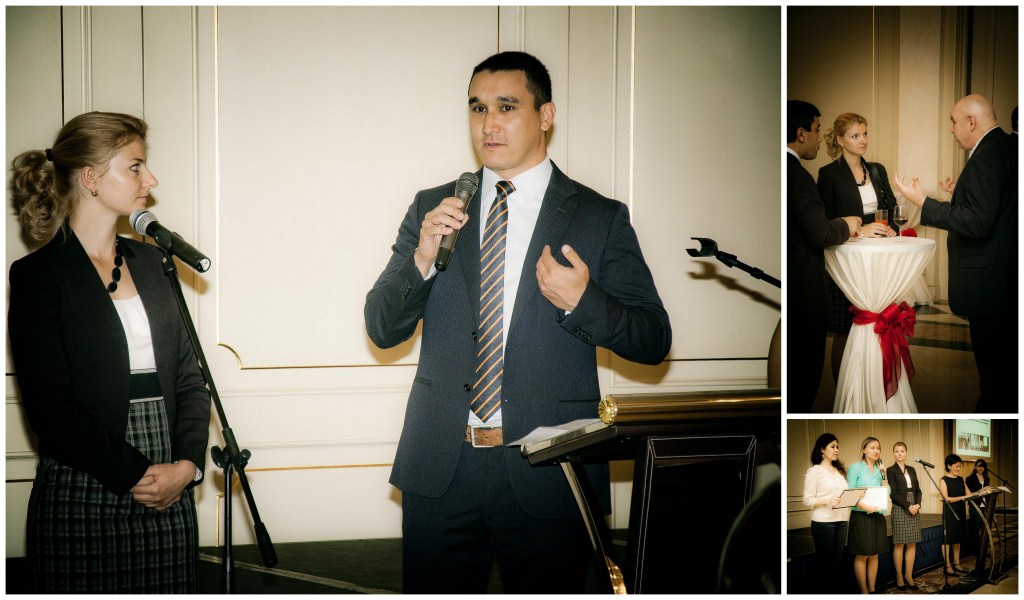
Eurasia Foundation Central Asia is a public organization that mobilizes public and private resources to help citizens actively participate in the creation of their own future. Eurasia Foundation is a private non-commercial organization that is aimed at increasing the civil responsibility, developing private entrepreneurship, improving education and healthcare systems in Central Asia.
The objective of the event was to express gratitude to the partners and donors that sponsor all the social projects of the Foundation. Among donors there were: embassies of the Netherlands, Denmark, Finland, Germany, companies such as Chevron Munaigas, TengizChevroil, ExxonMobil, World Bank, members of Parliament of the Republic of Kazakhstan.
The representative of the Foundation was announcing donors and it was my task to translate that as well as the words of gratitude.
When the official part of the event was over everybody started socializing and getting to know each other. It was nice and almost relaxing translation for me after a very hectic day at the Astana Economic Forum.
Tags: astana translation services, interpreter in Astana, Russian translation services, translator in Astana
Posted in About Kazakhstan, Astana, Foreigners in Kazakhstan, News, translation services
Comments Off on Russian-English translation in Astana at the donor recognition event
March 31st, 2012
On March, 30th -31st I worked in the Development Bank of Kazakhstan where OXFORD training conducted a seminar on loan restructuring. When I first heard of the seminar, I said to myself: “OK, here is an interesting challenge!” And it was, indeed, because the topic can’t be called a very common one and it’s definitely not something they teach you how to translate at the university, so I had to figure that out myself.

The good thing about the seminar is that I was informed well in advance which gave me enough time to familiarize myself with the subject. I was reading up on loans, debt crisis, world financial crisis, remediation management, austerity – it was quite a journey in which one article led to another one, one term to another one, one concept to another one. I should also mention that I had a presentation for the seminar beforehand and I felt more or less fine when I entered the bank on the first day of the seminar.
The trainer for the seminar turned out to be a nice Hungarian lady who had more than 20 years of experience in working in the banking sphere. Before the seminar I had a chance to ask her a couple questions to clarify some of the concepts that were still unknown to me and at 9.00 am we started our seminar. First 15 minutes went very well – the trainer stack to the presentation which started off with some theoretical background on loans, portfolio and corporate client. But already 15 minutes later participants started saying that they know the theory and they are more interested in its practical application. That means the trainer had to change her strategy and improvise. This means I had to improvise, too. Participants were happy they were no longer in “a school mode” with a lecturer but with someone who can actually answer many questions they have about loan restructuring and bad loan management. Our conversation got immediately livelier and more interactive. I was glad, too, because for an interpreter it is also much easier to work with the audience that is interested and active rather than with people that hardly stop themselves from falling asleep.
Mrs. Esther (our trainer) talked about case studies that she was personally involved in, we learned that something a banker has to run a sausage factory and that a bank might have 65 bouchers among its personnel – all this being a part of crisis management. We also learned that it’s not always all about business, it’s about personal relationships, too, when it comes to bad loan management. We have learned other tricks, too. I always use the pronoun “we” because at any seminar I learn as much as other participants do and this is something I simply love in my job that is a source of my constant development. Without the seminar I would have never looked up “collateral”, “outstanding account”, “coverage”, and others.
Looking forward to more seminars and more things to learn!
Tags: english translator astana, english-russian translator, translation in astana, translation in Kazakhstan, translation of banking terms
Posted in About Kazakhstan, Astana, Foreigners in Kazakhstan, translation services, Workshops
Comments Off on Translation for the Development Bank of Kazakhstan
March 2nd, 2012
This time I worked in the National Testing Center providing English-Russian translation at a series of lectures on evaluation in education.

The lecturer, Dr. Shonau, who came from the Netherlands, gave an overall view on the education system in the Netherlands, on the role of examinations and test in education. He explained different types of taxonomy models: that of Bloom and Romiszowsky, that are the basis for test constructing. Lectures touched upon test types: multiple choice tests, open end tests, written and practical tasks and the ways how to best evaluate each of them. The whole day was dedicated to the final examination and its administration and evaluation criteria as it as done in the Netherlands. Participants: those who develop test items, put them together in a test and later assess the results, took great interest in that part since the final exam that combines both school leaving and university entrance exam in Kazakhstan will no longer exist. The discussions are held as to how change the format of the exam and what is the best practice in the world.
It is obvious that there are differences between the education system in the Netherlands and that in Kazakhstan but still there are similarities, too, and both countries win from learning from each other’s experience.
Tags: english translator almaty, english-russian translation, translation astana, translation Kazakhstan
Posted in Astana, education abroad, Foreigners in Kazakhstan, translation services, Workshops
Comments Off on English-Russian translation at the National Testing Center
February 26th, 2012
For a week I worked at the National Cardiosurgery Center where Siemens conducted training for surgeons. I have already interpreted a similar training in Karaganda last year so I knew what to expect this time.

Training was dedicated to the special system and its applications that are used in such medical examinations as electrophysiology and hemodynamics. We started with the general information about the application, with the ways of registering a patient in the system database, with different ways of measuring pressure in heart chambers and vessels, so in the beginning my translation was more IT related. However, when we moved onto more specific questions such as catheter pullback sequence, translation became very specific in terms of medical vocabulary – atrium, ventricle, shunt, mitral valve, superior vena cava, end diastolic pressure, etc.
The training was “hands-on”, i.e. hands on the patient, doctors were performing their usual daily procedures while learning about the possibilities of the programme. Over this week I have seen about 15 operations and now feel like a cardiosurgeon myself 🙂 I have definitely learnt a lot about heart and the way it functions. I should say I am really impressed by the work that the doctors do every day. Many of them are very young and yet so professional, you could trust them with your life and heart without any doubts!
Tags: English translator in Astana, medical translation astana, siemens kazakhstan, training in astana
Posted in Astana, Foreigners in Kazakhstan, Siemens, translation services
Comments Off on Siemens training at the National Cardio Surgery Center
February 15th, 2012
First I would like to give some background information on the International Exhibitions Bureau (BIE) and how it is related to Astana and my work.

I am sure that many people have heard of the Universal Exhibition – for example the one for which the Eiffel Tower was built. Something similar but of a smaller scale (not a universal but a so-called recognized exhibition) is planned for 2017 and Astana is bidding to host this exhibition. Astana’s main competitor is Liege (Belgium). The decision on the host country will be made by the end of 2012 and in order to facilitate this decision the Enquiry mission visited both Astana and Liege to see if the cities are able to host several millions of visitors that will come to see the exhibitions. This is how 9 delegates of BIE found themselves in Astana in March, 12-16. It was my job to provide both simultaneous and consecutive translation during the visit. It goes without saying the programme was very tight so I will only mention events in which I was involved myself.
March, 11 – arrival day. Organizers of the visit decided to make it an “easy” day for the delegates and use some time before the official part of the visit to introduce guests to the Kazakh culture. That is why the first day was spent in Khan Shatyr, Pyramid and Palace of Independence where guests got a chance to visit the Ethnical Kazakh Village where the Kazakh traditions (including a traditional wedding, dances, jewellery, handcraft, etc) were shown.

March, 12 – beginning of the official programme
My main task on that day was to provide simultaneous translation during the presentations aimed at proving that Astana has enough capacity to host the EXPO 2017 – financial, economic, political.

March, 13 started with the meeting with the Minister of the Interior Mr.Kassymov at which the political situation in the country was discussed.

It was then followed by the excursion to the newly built TV and radio center where we were shown the future news rooms, studios and other facilities of the center.

After a number of presentations delegates left for a working lunch with the Minister of Finance and the Minister of Foreign Affairs where I was translating as well.
March, 14 was marked by the meeting with the President Mr. Nazarbayev who emphasized the political will to support the idea of EXPO 2017 being held in Astana. The delegates then visited Eurasian National university where a meeting with the Minister of Education and Science, students and academicians was planned. I graduated from this university 2 years ago and it was a very interesting feeling to come back to my alma mater not as a student but as a simultaneous translator. I continued my translation at yet another working lunch, this time with the Mayor of Astana.
March, 15 was another day of presentations on the future site of the EXPO and the future use of EXPO facilities since it is very important to invest in something that will last longer than just 3 months of the EXPO.
When I wasn’t in a booth doing simultaneous translation, I was down in the conference room to help with the consecutive English-Russian translation.

On the March, 16 together with the delegates I left for Almaty where a tour of the city and its surroundings by helicopter was organized. The official visit of the Enquiry mission finished with the internal meeting the results of which will hopefully have a positive impact on the final decision.
Tags: Astana expo 2017, english interpreter astana, English to Russian translator Karaganda, simultaneous translator Astana, translator almaty, Translator Astana
Posted in About Kazakhstan, Advice column, Almaty, Astana, Exhibition, EXPO 2017, Foreigners in Kazakhstan, News, Sessions, Simultaneous translation, tours in Astana, translation services
Comments Off on EXPO 2017 Enquiry mission visit to Astana through the eyes of interpreter
February 13th, 2012
On November, 17th I worked as a simultaneous English-Russian interpreter for ENRC seminar. The seminar was dedicated to a new change management strategy and to the ways of its implementation.

The seminar was interactive; it started with a simulation game: participants were split up into groups, each group being Employers, Employees or Consultants. Participants had a very fruitful discussion; they genuinely played their roles and drew some interesting conclusions.
The seminar was not too difficult as far as translation was concerned, it was quite a general discussion, however there were some specific business terms such as BBR (business benefits realisation), KPI and PPI (key performance indicators and process performance indicators), etc.
The seminar was mainly conducted in Russian with some presentations made in English, so for the most of the time it was Russian-English translation.
It was my first time working with ENRC (Eurasian National Resource Corporation), one of the major natural resources groups with mining, processing as well as logistical and marketing operations. As always, it was an interesting experience for me.
Tags: conference interpreter astana, english translator astana, English-Russian simultaneous translation, ENRC, russian translator astana
Posted in Astana, Foreigners in Kazakhstan, Simultaneous translation, translation services, Workshops
Comments Off on English-Russian Interpreter for Eurasian National Resource Corporation
February 7th, 2012
 Last week the award-winning movie “The Artist” premiered in Astana and I was asked to translate it. Those who are familiar with the movie might raise their eyebrows – what’s there to translate in a silent movie? Well, there are subtitles here and there and it was my job to translate them while the movie was being shown to the audience. Ambassadors and other representatives of the international community of Astana showed up in the cinema and that is why the translation from Russian to English was needed.
As easy as it may sound, it was not easy at all: first of all, subtitles were shown for a fraction of a second so I had to read and translate with the speed of light. Secondly, it is a movie, not a contract where the translation is very dry and straight to the point. If an actor shouts (silently) “Oh my God”, I can’t simply render his words into another language; I need to act, too. At least a bit.
It was a quite unusual yet very interesting experience for me; I had to use all my translation skills: always be ready in case a new line of subtitles appears on the screen, read fast, think even faster and translate in a way that is stylistically relevant to the scene in question. Quite a challenge but a fun one!
Tags: translation in astana, translation of subtitles, translator russian-english
Posted in Astana, Foreigners in Kazakhstan, translation services
Comments Off on Translation of “The Artist” in Astana
January 19th, 2012
It happened so that two weeks in a row I worked with the French companies in Astana and I decided to combine these two assignments into one article.
First I worked with Air Liquide, a leader in air gases production, doing both French into Russian and English into Russian translation. We had some meetings in KazMunaiGas, Kazakhstan’s national oil and gas company, and we discussed future business opportunities.
Then I worked with Groupe Euralis, one of the most important seed companies in Europe. Mr.Campion, Export Director had a meeting with the Ministry of Agriculture for which he needed a French-Russian interpreter. He made a presentation on the general Groupe Euralis structure and then moved onto a more specific field – company’s seeds products, such as corn, sunflower, rape-seed, sorghym and soybeans. The representatives of the Ministry answered questions regarding Kazakhstani legislation base as far as the use of foreign seeds is concerned, they also explained the procedure for foreign companies to register in order to be able to introduce their products in Kazakhstan.
Hopefully both meetings will lead to a mutually beneficial partnership for Kazakhstan and the French companies.
Tags: French companies in Astana, french interpreter in Astana, french-russian translation astana, interprète français-russe astana
Posted in About Kazakhstan, Astana, Foreigners in Kazakhstan, Le Français, News, translation services
Comments Off on English and French interpreter for Air Liquide and Euralis Group
December 28th, 2011
For two weeks in July I worked as an English speaking assistant/English translator for the National Geographic journalist John Lancaster and photograph Gerd Ludvig. National Geographic will produce an article on Astana so the journalists were sent on “a field trip” to find out about Kazakhstan’s culture, traditions, history as well as picture a modern life of the Kazakhstani society.

I was very excited about the assignment that I had: I did all the administrative work such as fixing appointments, getting entrance permissions, finding the right people to talk to, but also I did things I wouldn’t otherwise have done: attending traditional Kazakh weddings, participating in a ballet performance rehearsal, interviewing dancers, builders, newly-weds, getting into a construction site, etc, etc, etc.
I have learned a lot about the right way of taking pictures: when, where, from what angle and with which lens. I’ve also learned that a good picture requires hours and sometimes days of preparation. For a photographer it is essential to be in the right place in the right moment.
The article will presumably be published in March but I have already read some bits and pieces and I have seen some of the selected pictures. I cannot reveal much but I can say one thing: I simply love it! The pictures are stunning. Having seen the pictures, I now look at my own city with a different perspective.
I am not sure if the National Geographic magazine with the article on Astana will be available in Kazakhstan but the article will be also posted online. Can’t wait to see the complete article!
Tags: Add new tag, assistant for journalists, english speaking asisstant in Astana, English translator in Astaa, Kazakh traditions, National georgaphic in Astana
Posted in About Kazakhstan, Astana, Foreigners in Kazakhstan, News, translation services
Comments Off on English translator/assistant for National Geographic journalists
Next Page »