You are currently browsing the archives for the Foreigners in Kazakhstan category.
December 14th, 2011
It was a great honor for me to work as a Russian-English translator in the Residence of France where Ambassador of France to Kazakhstan hosted a friendly “Ambassadors’ sandwich club”. Six Ambassadors met with the Member of Senate to discuss some topical issues. Ambassadors emphasized and Senator confirmed the close economic and political ties of Kazakhstan with European and Asian countries. They discussed Kazakhstan’s development over the last 20 years and the progress that the country has made in transition from the planned economy towards a market one.
It was a very friendly discussion where everybody was free to express his opinion; views were shared on the major industrial projects in Kazakhstan, on the implementation of new technologies, on the use of foreign manpower, on the joint projects that Kazakhstan and its foreign partners have, etc.
Ambassadors also touched upon the upcoming Parliamentary elections that will be held in January 2012. Congratulations were exchanged on the occasion of the 20th Anniversary of the Independence of the Republic of Kazakhstan.
Tags: French translation, Parliamentary elections, russian-english translation, translator for embassy
Posted in About Kazakhstan, Astana, Foreigners in Kazakhstan, News, translation services
Comments Off on Russian-English translation: Ambassadors meet Senators
October 12th, 2011
On October, 3-5 I was in Karaganda and provided interpreter services in the regional cardio surgery center where Siemens experts held a training for doctors – cardio surgeons. Two days before the assignment I was given a 720 pages book where I found terms like ECG waveform, ablation, hemodynamics, NBP (non-invasive blood pressure), and others.

First day started at 6am when I met with Siemens experts who would be conducting the training and we started our 3 hours car drive to Karaganda. At 9 am we entered the cardio center and met doctors, all of us were given gowns and shoe covers which was a reason for some laughs and we started our training. Our main focus is the equipment for electrophysiological studies, a so-called Sensis. Doctors in the center have worked with the equipment for a year so they were more than just familiar with it, still they had some questions and problems to be solved. Which is exactly what we came here for.
Once I got my head around all the curves and leads that exist in EP – electrophysiology, I felt much better then when I first heard about the upcoming translation- a mix of medical and technical translation, which is quite something, I should tell. But… it’s never time to relax because next day it turned out I would be interpreting during the operation. ‘’Oh my god!”, I said to myself and “yes, no problem” – to the experts. I’ve been in different places because of my job but never in the operation room where –what a surprise!- a person is being operated on.
First come the nurses, they prepare a patient for the operation, next one is the anesthesiologist, then the doctor, then us. Operation starts and lasts for more than 2 hours. I will skip the details but the main goal of the operation is to introduce catheters into the patient’s heart, to find a part of the tissue that instead of being an isolator conducts heart’s signals and to burn- “ablade” that part. By the end of those 2 hours everybody is tired but –just like in a movie- the surgeon is smiling and saying “Operation was successful”, then we all smile and go for a coffee. The training goes on.
Next day was the last day of the training and I am already on my way back home because my next assignment awaits me in Astana on the following day. It was a really good trip, I learned a lot and met nice people and now I am looking forward to the next training which hopefully will take place in Astana in December.
Tags: medical translation, siemens kazakhstan, translation in karaganda, translator in Karaganda
Posted in Foreigners in Kazakhstan, Karaganda, News, translation services
Comments Off on Translator in Karaganda: Siemens training for doctors
October 11th, 2011
On September, 16th I had a simultaneous translation at the International Accreditation Conference organized by the National accreditation center in Astana.

It was the first conference of this kind held in Astana, international experts from the US, Australia, UK, Germany and other countries came to the conference to share their experience in the field of accreditation.
The main topic of the conference was the establishment of the unified accreditation system, so that a good produced in one country and accredited and certified in accordance with the international standards could be accepted in other countries. Such a system would significantly reduce time and money that a producer spends on accreditation and certification and it is extremely important within the newly established Customs Union.
Kazakhstan and its NAC recently joined ILAC and should now meet all the requirements of the organization. Conference was interesting for all the participants, they were actively asking questions and making comments which is always a good sign.
I truly enjoyed this short but productive conference.
Tags: accreditation forum, conference interpreter astana, Russian-English simultaneous translator, simultaneous interpreter astana, simultaneous translation Astana
Posted in About Kazakhstan, Astana, Foreigners in Kazakhstan, Simultaneous translation, translation services
Comments Off on English-Russian interpreter for the International Accreditation Conference
October 9th, 2011
On August, 24th -26th there was another Medical Forum with participation of Koreans doctors for whom I translated from English to Russian. For 3 days patients with different diseases came to see the doctors and to get acupuncture treatment which is the area of expertise of these doctors.

Altogether we treated over 200 patients, among these patients there were people with spine diseases, neck pain, high blood pressure, obesity problems, etc.
My task was to facilitate communication between doctors and patients, to translate patients’ complaints and doctors’ prescriptions. I’ve dealt with a great number of medical terms, such as duodenum, spinal rupture, protrusion, etc. I’ve learned a lot about acupuncture, too. Also doctors gave some advice to patients regarding the best position for writing or working with computer, holding one’s posture. It’s very important not to have too much pressure one one’s spine otherwise it can lead to many problems. All this information seems to be well –known but in reality not many people practice it.
Patients were treated for 3 days in a row and the results were obvious. Those who had acute pain and couldn’t walk straight on the first day, were able to walk and bend easily on the third day. People who were waiting in the hall started making stories about acupuncture being a magical treatment. Of course it’s not about magic, it’s all about releasing the right muscles in the right spot. It’s true, though, that it helped many people so everybody started wondering when the acupuncture medicine office would be open in Astana. So far there is no exact information on that.
This assignment gave me a chance to be in a doctor’s shoes, running from one patient to another, treating over 150 people a day, not having a 10 seconds break. Being a doctor is very honorable but I guess I don’t regret being an interpreter J
Tags: english in Astana, english to russian interpreter, koreans in Astana, translation in astana
Posted in Astana, Foreigners in Kazakhstan, News, translation services
Comments Off on Medical translation in Astana
September 28th, 2011
September, 19th-23rd I spent in Almaty providing interpreting services at the 17th Central Asia international mining exhibition. I worked with the CEO and a sales manager of the Celik Granul, a Turkish company that produces low carbon steel shots for sandblasting and shotblasting.

I flew from Astana Monday early morning and the first two days we spent preparing for the exhibition, we set up our stand, located the catalogues, got to know other exhibitors. On Wednesday the exhibition started and a constant flow of visitors started immediately.
Visitors were from different walks of life: company owners, PR specialists, students, journalists, distributors, etc. Every time somebody came up to our stand I explained why low carbon steel shots are better then high carbon steel shots, why shots can be used for surface cleaning not just ones but several times, what is the better shotblasting equipment for that, and so on. We had a very colorful stand and we for sure attracted many people.
After the full working day at the exhibition center we were invited to a nice reception where all the exhibition participants could meet and connect in an informal way.
One day of exhibition passed after another and here I am at the airport again. Translation in Almaty is finished but next day more work is ahead in Astana!
Tags: english translator almaty, translation almaty, translator almaty, translator for exhibition
Posted in Almaty, Exhibition, Foreigners in Kazakhstan, translation services
Comments Off on Translator in Almaty at the Mining Exhibition
August 24th, 2011
I just came back to Kazakhstan from my trip to Europe and on the same day I left for Aktau, a city on the Caspian Sea, to provide simultaneous translation services to the Ministry of the Environment Protection of the Republic of Kazakhstan.

Conference of the Parties to the framework convention of the marine environment of the Caspian Sea was held in Aktau with the participation of all the Caspian littoral countries: Azerbaijan, Islamic Republic of Iran, Kazakhstan, Russian Federation, Turkmenistan and UN Secretariat.
On the first two days there was discussion at the level of experts and working groups that touched upon protocols to be signed by the Ministers of Environment Protection of the five countries. Discussion were hot and lasted till midnight or even longer. But it was worth it: by the end of the third day the Ministers signed a protocol which from now on will be called the Aktau Protocol. This is the first protocol that was singed over the last eight years of work so everybody who participated at the Conference was very proud of this accomplishment.
After the signature of the Protocol there was another meeting between the Mayor of Mangystau oblast’ (which is where Aktau is situated) and the UN representative in Kazakhstan. I was asked to consecutively interpret during this meeting. The meeting was short but fruitful and its outcome is that there is a possibility for cooperation between the UN agencies in Kazakhstan and the region.
Tags: Aktau, English-Russian simultaneous translation, simultaneous translation in Aktau, translator kazakhstan
Posted in About Kazakhstan, Aktau, Foreigners in Kazakhstan, News, Simultaneous translation, translation services
» 1 Comment
June 12th, 2011
On the June, 1st I provided interpreter services at the II Korean-Kazakhstani Medical Forum. Representatives of 6 different hospitals flew over to Astana to have a presentation of their achievements in treating cancer, cardiovascular diseases, spine injures, etc.

I was assigned to work with Mr. Kyung Woo Park, Deputy Director of the International healthcare center in Seoul National University Hospital. In his presentation Mr. Park touched upon new ways of treatment of ventricular septal defect and other heart diseases: not with the help of bypass surgery but using the percutaneous coronary intervention (PCI).
Korean doctors suggested cooperation to their Kazakhstani colleagues, several MOIs were signed and now Kazakhstani patients can be sent to Korea to undergo the necessary treatment.
Once the official part of the forum was over, the more interactive one began. Those who were interested could come up to the booths where the hospitals were present and they could ask questions and exchange contact details.
It was my first experience in translating at the Medical Forum and I learned a lot while preparing for that assignment. I also got to meet and discuss with many interesting people and I would like to personally thank Mr. Park for all the information that he shared with me.
Tags: english interpreter astana, english-russian translation, russian interpreter services, russian translator astana
Posted in Astana, Foreigners in Kazakhstan, News, translation services
» No Comments
May 19th, 2011
On May, 4-5th I worked as a Russian-English simultaneous translator at the IV Astana Economic Forum. The Forum gathered experts, international organizations, business communities, transnational companies, research insitutes and universities.

There were eight Nobel Prize laureates present among which John Nash, Eric Maskin, John Aumann,there were also CEO’s and Chairmen of different companies worldwide. From the Kazakhstani part there were government representatives, as well as those of the business.
I worked in a Green Economy section with the representatives of UNECE, mostly dealing with the concepts such as green growth, green development, etc. There were speeches on the advantages of the green economy, approaches and good practices in the UNECE region in terms of greening economy.
There were also some discussions related to the Ministerial Conference that will be held in Astana in September, that is why I accompanied some participants during the negotiations at the Minsistry of Foreign affairs and the Ministry of Environment Protection next day.
I will be working with UNECE in the end of May again, so I am looking forward to meeting the participants again.
Tags: Astana Economic Forum, Astana Economic Forum translator, conference interpreter astana, english kazakhstan translate, interpreter Astana, kazakh to russian translator, russian to english translator, Russian-English simultaneous translator, Russian-Kazakh translation, translator needed almaty, translator needed astana, translator needed berlin, translator needed karaganda
Posted in Astana, Foreigners in Kazakhstan, Simultaneous translation, translation services
Comments Off on Simultaneous Russian-English interpreter at the IV Astana Economic Forum
May 2nd, 2011
On April, 18-22 I worked as a conference interpreter at Nazarbayev University. I was doing simultaneous translation – professors of Public Policy from National university of Singapore were invited as lectors for a week long seminar for government officials.

Seminar was divided into several parts: Professor Asher made a presentation on what makes countries grow: implications for Kazakhstan. Professor spoke about main drivers of growth, knowledge economy and knowledge management, national and firm competitiveness. Second lecture was dedicated to the public finance and budgeting, that lecture mostly covered accrual accounting in comparison to cash accounting. Pr. Asher gave many examples of international practice, including IMF code of good practices on fiscal transparency.
Next lecture was on the State Enterprise reform and on Public Private Partnership, including different models, risk classification, etc.
Two following days lectures were held by Vice dean and Associate Professor, Dr. Fritzen. His main topic was transformational leadership in the public sector with the focus on strategic triangle of effective policy desing, effective implementation and strong stakeholder support. Participants took a great interest in that lecture, as well as in that on controlling corruption. Dr. Fritzen made his two sessions interactive, he encouraged participants to come up with the examples that are relevant to Kazakhstan.
The seminar was a great experience for me since I worked in a pair with a very experienced conference interpreter, I had a chance to learn from her and ask for her opinion on different aspects of being an interpreter.
Tags: conference interpreter astana, interpreter for seminar, kazakh translation, simultaneous translation Astana, translation agency astana, translation company astana, translator kazakhstan
Posted in About Kazakhstan, Advice column, Astana, Foreigners in Kazakhstan, Sessions, Simultaneous translation, tours in Astana, translation services
Comments Off on Conference Interpreter at Nazarbayev University
April 10th, 2011
Recently I came back to Astana from a business trip to the regions of Kazakhstan. National Innovation Fund of the Republic of Kazakhstan organized a seminar that was held in all the cities of the country to which I was invited as an English interpreter for the experts from INNO Group (Sweden).

First seminar was held in Karaganda and was followed by a number of seminars in Aktau, Atyrau, Kostanay,Uralsk, etc. In 8 days we covered 7 cities which meant one flight a day.
The seminar touched upon issues like transfer of technology, licencing, patenting, intellectual property and the like. Target group of the seminar was university professors and scientists who come up with inventions and should know how to introduce these inventions to the market and how to protect their intellectual property.
INNO Group is a German company with offices all over Europe that has a 20+ years of experience in the field of transfer of technology. The whole concept is quite new in Kazakhstan, that is why it was very important to listen to the experts and to participate in the seminar. INNO Group experts, Mr. Biorkman and Mr. Grankvist, in the course of the seminar among other things aslso had a couple of case studies which made the seminar very interactive and dynamic.
We were warmly welcomed in every city and every university, we visited a laboratory in Kostanay where we we shown the latest inventions of the university scientists. All in all it was a very nice and interesting trip, I have definitely learned a lot about innovations and transfer of technology, business incubators and copy rights, business angels and validity of patents. There is another series of seminars planned, so I hope that my list of newly acquired knowledge will be even longer!
Tags: english interpreter astana, english to kazakhstan translation, Inno Group Kazakhstan, interpreter Aktau, interpreter Atyrau, interpreter Karaganda, interpreter Kostanay, interpreter Petropavlovsk, interpreter Uralsk, kazakh translation, kazakhstan translation, NIF Kazakhstan, Russian interpreter Almaty, Russian interpreter astana, seminar interpreter
Posted in Aktau, Almaty, Astana, Foreigners in Kazakhstan, Karaganda, Kostanay, Petropavlovsk, translation services, Uralsk, Астана
Comments Off on English Interpreter for INNO Group Seminar
March 30th, 2011
On March, 16th -18th there was an exhibition Agritek 2011 which I visited as English interpreter for Mr. Vinter, area sales manager of a Danish company Unibolt A/S.
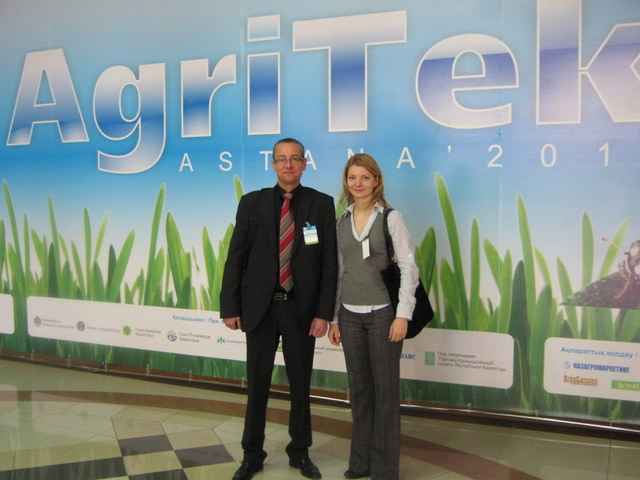
It was not the first time that we worked with Mr. Vinter and not the first exhibition that we visited. It’s been a year since we first started working and during that year we had a lot of meetings in Astana, Almaty, Moscow and other cities. I am also quite familiar with the Unibolt products given the fact that I did website translation into Russian for that company.
Unibolt A/S is a European leader in manufacturing bolts and other fasteners for agriculture machinery that is the reason why we met a number of agriculture companies at the exhibition that are potential customers of Unibolt. We also held meetings with other companies outside the fair.
We are planning yet another trip to Russia next week: in Moscow we will meet the head of a company that plays a big role in Russian agriculture market. We are looking forward to that trip and hope that it will be as successful as we expect it to be.
Tags: interpreter Astana, Russian interpreter astana, russian translator for a meeting, translator for exhibition, translator for fair, website translation into Russian
Posted in Astana, Fairs, Foreigners in Kazakhstan, News, translation services
Comments Off on Interpreter in Astana for Unibolt A/S
March 16th, 2011
I just got back from Berlin and there is already more work ahead: on February, 28th I provided interpretation services for the National Business Forum in Astana.

National Business Forum (NBF) serves as a kind of bridge between government and business, so there were representatives from both sides. Prime Minister Mr.Massimov was the first one to deliver a speech, then there was the panel discussion followed by more discussions at the round tables. My task was to interpret for Mr. Shinsato, who was invited to the NBF as an international expert. Mr.Shinsato delivered an extremely interesting speech on change management focusing on lean production and kaizen. I really love my job since it allows me to constantly learn from the people I work with. If not for the forum, how would have I found out about kaizen?
Having delivered his speech, Mr.Shinsato was actively participating in the discussion, so I was doing what is called „chuchotage“ – a kind of simultaneous interpretation without any special equipment. Interpreter just sits next to a person he/she translates for and does the simultaneous translation while another speaker delivers a speech.
The discussions were vivid, participants were active and genuinely interested in the topic, so there was a lot to translate. Mr.Shinsato was also interviewed by a local channel and I translated that as well.
It was a real pleasure to translate Mr. Shinsato as he is a very experienced speaker, he attracted and involved the audience, made some jokes and at the same time got his message across, so everybody enjoyed the time with him.
Tags: english interpreter astana, kazakhstan translation, kazakhstan translator, Russian interpreter astana, simultaneous translator in Astana
Posted in About Kazakhstan, Astana, Foreigners in Kazakhstan, News, Simultaneous translation, translation services
Comments Off on Interpreting at the National Business Forum
January 11th, 2011
Since April I’ve been involved in two projects of ALSTOM TRANSPORT in Kazakhstan. These are two strategic projects: delivery of electric locomotive and construction of tramway line in Astana. I work mostly as a technical Russian-English translator, sometimes also as a Russian-French translator since ALSTOM is a French company.
The projects are very big so we had several working groups: technical, legal, financial. I mostly work in a technical group where we talk about electric locomotive manufacturing process, about its parameters and technical description. At the beginning I didn’t know much about „locos“ – as we call electric locomotives, I saw no difference between BoBo, double BoBo and CoCo locomotives, but step by step I was getting more and more into it. Now I know why it is that important for a locomotive to have an unbalanced lateral acceleration up to 1.0 m/s2 and what impact it has on the rails and on the locomotive bogie.
But it’s not always the technicians that I translate. Sometimes we have a hectic schedule and after interpreting at the technical meeting, I have to run to a finanical one, where specialists discuss cash flow, overheads and structure of Joint Venture. I also became familiar with the notions such as P&L, CAPEX and OPEX. I might also translate at a legal meetings where I deal with words as precedent conditions, preemptive right and fundamental breach.
Everybody involved in the project worked quite hard, often without days-off and working long hours but it was worth it – on the 27th of October, 2010 in Paris there was signed the Contract by the President of the Republic of Kazakhstan and the President of France. Now the project is officially launched which means we have more work ahead!
Tags: english translation service in Astana, engslish-russian translator in Astana, French-russian translator Astana, Russian interpreter in Astana, russian translator astana, technical translation Astana, Translator Astana, translator in Astana
Posted in About Kazakhstan, Advice column, Almaty, Astana, Foreigners in Kazakhstan, Sessions, tours in Astana, Uncategorized, Астана
Comments Off on Russian Interpreter in Astana for ALSTOM
December 2nd, 2010
On the 10-11th of November I worked as a simultaneous interpreter at the ECO Conference on disaster risk management. There were presented 8 countries of the Organization as well as UN, WHO, UNISEF and other international organizations. The conference was hosted by the Minister of Emergency situations, so he was the first one to be interpreted, followed by ECO Deputy Secretary General, UNDP Resident Representative in Kazakhstan and by the Special Representative of the UN Secretary General.
Unlike previous simultaneous translation, this one was quite specific: there were presentations on seismic risk reduction, on global campaign „Making cities resilient“, and others. The main topic was the natural disasters: earthquakes, landslides, floods, wildfire and the impact that they have on overall safety with the focus on school and hospitals safety.
There were some hectic moments for the interpreters when one of the speakers delivered his speach in Persian instead of English. It was quite a surprise for us but we managed with the help of his colleague who volunteered to interpret into English so we could intrepret him into Russian. The other presentations were fine although sometimes overwelmed with figures, dates and places. But being a simultaneous interpreter, we have to deal with this fact, as well as with the lenght of a presentation and with the speed at which this presentation is given.
Totally I worked 14 hours the first day and then some more hours the following day. It’s not easy, I must admit, but it is very interesting at the same time.
Tags: English-Russian simultaneous translation, Russian interpreter in Astana, simultaneous interpreter astana
Posted in Astana, Foreigners in Kazakhstan, News, Simultaneous translation
» No Comments
October 25th, 2010
Not much time passed since I worked as an interpreter for Deutsche Welle in Karaganda and I am already on my way to Aktau (a city by Caspean Sea) to perform English-Russian translation of the technical workshop again.

The workshop was conducted by Marc Seidel at the „West“ radion station mostly for the sound engineers and DJs. Journalists and news readers were also willing to participate, so Marc tried to „make everybody happy“ and cover as many topics as possible.
The radio station is quite new, so most of the staff is young, energetic and excited about learning new things. First we had quite a technical introduction including the digitalization of the sound, bitrate impact on sound quality, sampling frequency, MP3 etc. Then we had more practice: participants learned about different types of microphones, they got to work with the digital recorder, they even produced a story by using various ambient sounds and also they did a vox pop by recording different people’s answers to the same question. They also dealt with some post-production software which seemed to be a lot of fun for the participants.
The newsreaders also had a chance to benefit from a workshop: on the last day of the seminar we did some exercises in order to train newsreaders to select the most important items for the news and to present the news in a professional way.
The participants and the management of the radio station were so friendly and so genuinely interested in the workshop that it was a real pleasure to work with these people. Our week long seminar is finished and they have already requested for more seminars in the future, so I guess it was not the last trip to the Caspean Sea!
Tags: Deutsche Welle in Kazakhstan, Deutsche Welle workshop, english to kazakh translation, Interpreter in Aktau, Russian interpreter, russian interpreter services Kazakhstan, russian to kazakh translation
Posted in Aktau, Foreigners in Kazakhstan, News, translation services, Workshops
» No Comments
September 30th, 2010
The other day I received a request for interpreting services for the interview with the Prime Minister of Kazakhstan, Mr. Karim Massimov. I was contacted by Fabio Ferlito, the Project Development Director of Business Focus, the London based communication agency aiming to publish a report on Kazakhstan’s growing economy in Bloomberg BusinessWeek magazine.

We met with Fabio a couple of hours before the interview so that he could give me more information regarding the magazine and the interview itself. Having done so, we went to the Ministry of Foreign Affairs and we were then accompanied to the Government House where the interview was held.
The interview started and it turned out that the Prime Minister spoke perfect English so there was not much for me to do. I will not say what were the Prime Minister’s answers because this should be read on the pages of the Bloomberg BusinessWeek magazine 🙂 But this was not the end of the day, the interview was followed by another meeting at the Ministry of Foreign Affairs and also by a number of interviews with the Cabinet of Ministers which were still to be arranged.
I worked some more days with Fabio, more as an English speaking assistant rather then interpreter. I made some calls on his behalf, searched for the information that was only available in Russian, communicated with the Ministry of Foreign Affairs in order to arrange visa issues, etc.
Fabio’s visit to Kazakhstan (first visit but hopefully not the last one) coincided with the Astana Day which is July, 6th , so we had a chance to participate in this huge celebration with lots of people, music, light, shashlyk and overall fun.
Once the first steps were taken, Fabio left Kazakhstan and his colleagues came here to continue his work on the project which will probably last for a couple of months. Hopefully soon all those 4,7 million people that read BusinessWeek worldwide will be able to find out more about our country, its economy, political policy and reach resourses.
Tags: Astana Day, astana translator, English assistant in Astana, kazakhstan translation, Russian assistant in Astana, translation at the Ministry of Foreign Affairs, translation for Prime Minister
Posted in About Kazakhstan, Advice column, Astana, Foreigners in Kazakhstan, tours in Astana, translation services
» 1 Comment
August 11th, 2010
For a week I did English-Russian translation of a technical workshop in Karaganda, I worked together with Marc Seidel, a trainer from Deutsche Welle Academy.

I have already worked as an interpreter for Deutsche Welle before, but last time it was a journalistic workshop. This time it was a workshop for technicians and sound engineers of the radio station TEX, its aim was to improve sound quality and to make people at the radio station aware of any problem that may occur on an every day basis.
Since it was a technical seminar, the words that I dealt with were also quite technical, such as transmitter, sampling frequency, bitrate, data reduction etc. We talked about how analogue sounds become digital ones, how they are then transmitted and broadcasted. Stereo and mono sounds were also discussed, as well as the difference between stereo sounds and two-channel sounds.
Mr.Seidel also had some music items with different problems, for example in one item low frequencies were missing, in another one there were not enough teble. For the participants it was very interesing to find out the problem and its reason. Thus they trained their ears to immediately recognize the problems. We also went to the antenna where the transmitter was located to check if everything was fine with it and if there was anything wrong with the settings.
The atmosphere of the workshop was very nice, participants felt free to ask any questions, so the workshop was quite interactive and everyone seemed to be happy to learn something new.
Tags: Deutsche Welle workshop, English to Russian translator Karaganda, interpreter in Karaganda, technical translation Kazakhstan, translation services Kazakhstan
Posted in Foreigners in Kazakhstan, Karaganda, News, translation services
» 1 Comment
July 27th, 2010
For a couple of months I’ve been involved in a JICA project first as an English-Russian translator of several documents, then as a Russian interpreter at the meetings.

A couple of years ago a huge projest was launched – construction of a new airport of Astana and remodeling of its runway and its facilities. Construction is done, so now the project has entered the appraisal phase, that is why an independent consultant came to Astana to conduct a survey. That is how I met Mr. Yamaguchi. As I mentioned, first I did the written translation of a questionnaire and of several letters to International Airport Astana, so I got to know the vocabulary related to airport: apron, taxiway, aircraft boarding bridge and other words. Knowing those words was quite helpful when Mr. Yamaguchi arrived to Astana and held several meetings with the airport authorities.
Our first meeting was in the Ministry of Transport and Communication, in the Civil Aviation department, where Mr. Yamaguchi made a presentation of the purpose of his visit. Next meeting we had was at the airport, where there were discussed issues related to the condition of some airport facilities and, specifically, of the apron. This meeting was followed by another one in the air traffic control tower. That visit was a very interesting experience for me because I got to see the operation of the airport from inside. It looked almost like in a movie when a controller spoke to pilots and gave them directions. I was definitely amazed by the work of these people! This place has a restrict access to it so if I hadn’t been an interpreter I would have never entered that building. That is another agvantage of being an interpreter!
We continue working together with Mr. Yamaguchi, his next visit is expected in October, so I look forward to more meetings.
Tags: Astana interpreter, International Airport Astana, kazakh translator, russian interpreter services, russian translator for a meeting, translator english to russian in astana, written translation
Posted in Astana, Foreigners in Kazakhstan, News, translation services
» 1 Comment
July 19th, 2010
In the last couple of days I translated for His Excellency Ambassador of Philippines Jesus Yabes who came to Kazakhstan to present credentials to His Excellency State Secretary Kanat Saudabaev.

Ambassador of Philippines Jesus Yabes & State Secretary Kanat Saudabaev, Palace of President

State Secretary Kanat Saudabaev (right) & Ambassador of Philippines Jesus Yabes
On the first day, I met with the Ambassador and with Mr. Demdem, Third Secretary and Vice Consul. We went on a city tour. For me, it was a usual thing to do—to go on excursions—but it was my first time to be a tour guide myself. We drove around the new part of the city, stopped by the Ak Orda (Presidential Palace), passed by Baiterek, Han Shatyr and other sights in Astana. We also went to the Catholic Church and attended Mass.
The following day, we were invited to the Ministry of Foreign Affairs. I translated for the Chief of Protocol, who instructed Mr.Yabes, as well as three other Ambassadors, regarding how the ceremony of presenting the credentials would be conducted. Then, we met with the Deputy Minister of Foreign Affairs and discussed relations between Kazakhstan and the Philippines.
On the 22d of June, we also went to the Ministry and, from there, we drove to Ak Orda, the Presidential Palace. The ceremony started. The Ambassadors, accompanied by their wives or consuls, were invited one by one to present their credentials. Having done this, His Excellency Mr. Yabes attended a bilateral meeting with Mr. Saudabaev, where I had the pleasure of translating from English to Russian and from Russian to English. This was followed by a press-conference. Mr. Yabes delivered a speech and I translated again.
I felt honored to have the opportunity to meet with and to translate for His Excellency Ambassador Jesus Yabes, it was also very nice to meet the same people at the Ministry of Foreign Affairs with whom I had the pleasure of working before during the NATO Security Forum and the Congress of Leaders of World and Traditional Religions last summer. I was also very glad to meet Mr. Demdem who is a professional first of all and a very nice person, too.
Tags: city tour Astana, Ministry of Foreign Affairs Kazakhstan, Palace of President, translation at press conference, translation for Ambassador, translation for State Seceretary, translation from English to Russian, translation services Astana, translation services Kazakhstan
Posted in About Kazakhstan, Astana, Foreigners in Kazakhstan, News, Sessions, tours in Astana, translation services
» No Comments
July 7th, 2010
On June, 5-11 I provided interpreting services to Kyle James, a journalist from Deutsche Welle who came to Astana to conduct an in-house training for Radio Astana.

Interpreting services for Deutsche Welle in Astana
We worked closely with several journalists from that radio station, the training covered producing news blocks, as well as feature programmes.
Kyle James gave some recommendations concerning the length of a programme, the music used under the text, the programme layout, etc. He worked with each journalist individually, so the training was very successful and interesting, too. We also worked with the journalist from the Kazakh department, so I did some English-Kazakh and Kazakh-English translation. Mr. James played some programmes that he produced himself, he also talked about different ways of presenting the information, how a reporter can use natural sounds and by doing so make listeners follow the reporter. It turned out that the European or American styles are quite different from the one that people are used to here. Eventhough not everything of what was said could be applied to Kazakhstan, the journalists would like to try to produce their programmes in a new way. They were genuinely interested in the training,they raised a lot of questions and asked for some advice. Also before leaving Mr. James wrote down some guidelines which I translated from English to Russian, these guidelines can help a reporter make his/her story more dynamic and thrilling.
According to what they say, the journalists have learned many things. Me too, I’ve learned a lot in terms of radio journalism and in terms of new words, such as vox pop for example. Mr. James has left already but every now and then I put on the Radio Astana and listen to some feature programmes which have slightly changed because of the training 🙂
Tags: english to kazakh translation, english to russian translation astana, interpreter Astana, Interpreting services Kazakhstan, kazakhstan translation, russian to kazakh translation
Posted in About Kazakhstan, Astana, Foreigners in Kazakhstan, News, translation services
» No Comments
« Previous Page — Next Page »